IDRiM 2013 Conference

IDRiM 2013

Venue: Northumbria University, Newcastle upon Tyne, UK

Dates: 4-6 September 2013

The 4th Conference of the International Society for Integrated Disaster Risk Management (IDRiM 2013) together with the Dealing with Disasters International Conference (DwD 2013) will be hosted by Northumbria University in Newcastle upon Tyne, UK, from 4th – 6th September 2013. The theme of the conference is “From Opportunity to Action: Bridging the Gap between Disaster Reduction and Development through Science(s), Technology and People Centred Actions.”

DwD / IDRiM 2013 Overview

The focus of the conference builds on opportunities through science and technology, political will and behaviour change to address current crises and reduce risks for future generations. Whilst knowledge about the nature and context of disasters has proliferated, many potential actions for integrated disaster reduction remain far from realised. The disjuncture between existing opportunities and actions both present and anticipated is a complex problem of the disaster and development nexus. Driven by common objectives of survivability, there is a need to bridge gaps between disaster reduction and development through varied types of science (natural, social and others), technologies and people centric actions. This requires ‘smart awareness’, motivation and vision to enable combined disaster reduction and sustainable development at local and global levels. The conference aims to address opportunities for action through varied state of the art contributions from the worlds of disaster science, technology, policy and practice. It is also open to expertise less conventionally recognised within this field. It intends to stimulate a next generation of ideas and actions for disaster reduction.

Cross-cutting Themes

The conference focus solicits papers and sessions informed by cross-cutting themes of disaster management, sustainable development, resilience building, vulnerability reduction, risk assessment and governance, risk financing, living with uncertainty, transformative processes, cultural recognition and change, poverty reduction, wellbeing, climate change adaptation, integration science, disaster communication, innovation, communities of practice, and policy including dialogue from different disciplines related to risk. These cross-cutting themes from academic, policy and practice dialogues will for the purpose of this conference be considered interrelated, mutually informative and key to moving from opportunity to action. The conference focus will be maintained by reflecting on how theory, method and implementation presented by these processes can make a difference to the future of dealing with disasters.

Conference topics particularly encouraged

We are keen to receive proposals for papers or sessions relating to the following, though other contributions associated with the conference theme absent from this list will also be considered:

  • Understanding uncertainties to reduce gaps to action
  • Using poverty led actions to address disaster risk
  • Developing public-private-civil societal-academic partnerships in disaster and development work
  • Investing in safer human habitats – safety science – post disaster reconstruction and building resilience
  • Experiential and intuitive learning in disaster and development contexts
  • Engaging demographic change – child centred and elderly persons disaster risk reduction
  • Health and wellbeing centred disaster reduction
  • Social and economic mobility, displacement and adaptation
  • Visualisation and communication in disaster risk reduction
  • Social protection, insurance and human security
  • Risk governance, education, development and collective decision making
  • ‘The risk governance, scientific advisors, science and policy interface’ (This theme already identified as a Special Session – proposals for papers are invited)
  • Complex ‘Natech’ disasters – critical scenario development
  • Developing applications of forensic science, emergency management and disaster warning systems
  • A new humanitarianism

Conference Features

The conference will include plenary, parallel, poster, panel, ‘young scientists’ and doctoral sessions.

A full set of double blind peer reviewed proceedings will be produced with special editions of journals / book. Several publishers are interested in providing outlets for this event.

Further partnerships and sponsorships in progress.

Dates

December 15th Opening of official website and registration; abstract and session proposals by email;

March 30th Abstract and session proposals closing;

April 30th Notification of session and abstract acceptance;

May 15th Announcement of conference programme;

June 30th Deadline for early registration

July 15th Deadline for full paper submissions

July 15th Deadline for additional poster submissions

August 31st Deadline for normal period registration

Associated meetings and events at DwD2013 / IDRiM 2013 include:

IDRiM Society Board Meeting and General Assembly

British Festival of Science (BSF) 7th – 12th September, Newcastle including a specially hosted DwD/IDRiM 2103 high level panel on; ‘Communication and Disaster Reduction: the future of science, education and politics in negotiating uncertain nature’ (7th Sept).

Meeting of the Global Summit of Research Institutes for Disaster Risk Reduction

Meeting of the Disaster and Development Alliance – ‘UK Champions for Change Initiative’

Delphe – British Council / DFID meeting on ‘Disaster Education for Community Resilience’

Meeting of the Japan-UK Disaster Risk Reduction Study Programme

Board Meetings of at least three international journals focussed on disaster reduction

… other meetings and events to be added by June 2013

Full Program: Here


Contacts:

For more information please contact:
sz.dwdconf@northumbria.ac.uk

society@idrim.org

For Conference flier click here.

IDRiM 2012 Conference

IDRiM 2012 Conference

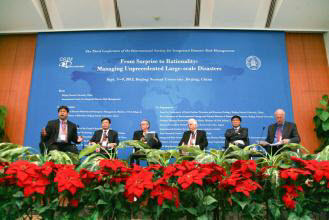
From surprise to Rationality: Managing unprecedented Large-Scale Disasters

The 3rd Conference of the International Society for Integrated Disaster Risk Management (IDRiM Society) was held at Beijing Normal University on 7-9 September 2012.

Purpose

The purpose of the conference was to promote discussion on integrated risk governance issues for large-scale disasters. Researchers in the field of disaster risk research from developed countries in North America, Europe, and East Asia and developing countries in Asia, Africa, and South America are invited to gather in Beijing to take part in this conference. Conference participants will spend three days engaged in intensive discussions on the scientific, technical, economic, financial, and educational issues regarding large-scale disasters. The ultimate purpose is to find new approaches to coping with natural disasters, identify ways to fill the gap between science and implementation, and enhance collective decision making.


IDRiM 2012

IDRiM 2012

Achievement and Results

The IDRiM2012 Conference was a great success. The three day conference included two invited keynote speakers, two panel sessions with the participation of well-known experts in various fields, 12 special specialized parallel sessions and a Young Scientist interactive poster session by young researchers. There were a total of 162 participants from 31 countries, of which 83 were from outside of China.

The conference started with opening remarks from Prof. Fanghua Hao, Vice-President of Beijing Normal University and Prof. Norio Okada, President of the IDRiM Society. The opening remarks were followed by a keynote speech by Prof. Haresh Shah from Stanford University (United States) on Integrated disaster risk management. Highlights from the first day included a plenary panel session where invited experts presented arguments and promoted discussion regarding Critical Issues of Unprecedented Large Scale Disasters (LSD), and the well-attended Young Scientists interactive poster session with more than 30 participants. Parallel session topics included risk assessment and modeling of LSD and new trends and development of disaster risk research; a session on models and management options for Natech risks and a session on monitoring, forecasting and early warning systems for LSDs. The first day finished with a reception and launching of the Global University Consortium for Integrated Disaster Risk Governance.

Prof. Douglas Paton from University of Tasmania, Australia, provided an insightful keynote speech on Disaster Resilient Communities: Personal, Community, Societal and Cultural Influences. This was followed by a plenary panel session on Integrated Risk Governance and Global Change with the participation of distinguished guests from Europe, US, China and Japan. The second day included parallel sessions concerning economic consequence analysis of LSDs and the promotion of catastrophe insurance schemes for risk management of LSDs. Global change, environmental risks and adaption, as well as risk governance issues such as education, communication and collective decision-making were the topics of two other parallel sessions. The General Assembly of the IDRiM Society was also held on the second day, followed by the conference banquet which promoted friendly exchange and networking and was the opportunity to award papers presented for the Young Scientist poster session.

The third and final day of the conference started with an important discussion on planning and management of disaster recovery and reconstruction following LSDs. Parallel sessions covered topics such as multi-hazards and cascading effects, economic consequences of LSDs, and disaster preparedness and post-disaster governance issues based on lessons from Algeria, China, Japan and Taiwan. The conference was closed with a wrap-up and summary session on lessons learned and emerging issues from the conference.


Full Program: Here

Spotlights

Best Young Scientists Awarded
During the IDRiM 2014 Conference the top 10 papers submitted to the YSS received recognition.
The first Prize went to Mimi Shi, from Beijing Normal University, China, for the paper entitled: “A Comparative study on key elements of post-disaster recovery process in the United States and China —Case study of Greensburg and Nanba”. The second prize was awarded to Nicholas Agam, Western University, Canada, for the work entitled: “Development of Inundation maps for the Vancouver coastline under a changing climate”, and the third place was awarded to Xing Wei, Beijing Normal University, China, for the paper entitled: “Risk assessment of agricultural production by crop forecast and prediction”.

IDRiM 2011 Conference

IDRiM2011 CONFERENCE

Reframing Disasters and Identifying Deficits in Risk Governance

The 2nd Conference (IDRiM2011) of the International Society for Integrated Disaster Risk Management (IDRiM Society) was held at the University of Southern California (USC) in Los Angeles, United States, on 14-16 July 2011. The conference was co-organized by the Disaster Prevention Research Institute (DPRI) of Kyoto University, and supported by the Japan Foundation, the International Institute for Applied Systems Analysis (IIASA), and the Joint Research Centre of the European Commission.

The conference theme, “Reframing Disasters and Reflecting on Risk Governance Deficits,” stemmed from the analysis of recent events including the Haiti and Chile earthquakes, the volcanic ash disruption to European air space (as well as interconnected airlines, businesses, and people around the world), and the BP Deepwater Horizon oil spill in the Gulf of Mexico. Furthermore, the devastating Tohoku earthquake and tsunami in Japan on 11 March 2011 which triggered the nuclear accident at the Fukushima Dai-ichi power plant have shown that even in a country with some of the best earthquake and tsunami construction and disaster preparedness and mitigation systems in place there are gaps in risk management. These events have highlighted several important points: the need to rethink the way we design our infrastructure and protection and mitigation barriers; the need to address/ manage disasters locally, but also the need to consider their potential impacts globally; and the need to identify and address risk governance deficits as well as the need for more transparency in the governance and management of high risk activities. Integrated disaster risk management is needed that uses multi-hazard, interdisciplinary, multi-stakeholder, and comprehensive approaches to disaster risk reduction.

Several well-known national and international speakers participated at the conference including six keynote speakers:

James Featherstone (Director, City of Los Angeles Emergency Management Department)
Kathleen Tierney (Director, Natural Hazards Center, University of Colorado, USA)
Detlof von Winterfeldt (Director, IIASA, Austria)
George Apostolakis (Commissioner, US Nuclear Regulatory Commission)
Erwann Michel-Kierjan (Wharton School of Business, University of Pennsylvania, US)
Yoshiaki Kawata (Kansai University, Japan)George Apostolakis (Commissioner, US Nuclear Regulatory Commission)
Erwann Michel-Kierjan (Wharton School of Business, University of Pennsylvania, US)
Yoshiaki Kawata (Kansai University, Japan)

The conference covered various topics including:

  • The Tohoku earthquake and tsunami in Japan on 11 March 2011.
  • Post-disaster reconstruction and recovery
  • Resilience as an approach to integrated disaster risk management
  • Megacities and disasters
  • Transportation systems
  • Critical infrastructure
  • Climate change adaptation, linking climate change and weather-related disasters
  • Conjoint natural and technological (Natech) disasters
  • Social vulnerability
  • Socio-economic strategies for disaster risk reduction
  • Information management and sharing
  • The Future and Limitations of Catastrophe Models
  • Disaster debris management
  • Terrorism risk
  • Young scientists research session

Full Program: Here

For more information please visit the IDRiM Society website at: www.idrim.org.

E-mail inquiries may be sent to: society@idrim.org

IDRiM 2010 Conference

Sharing IDRiM experiences under different socio-economic and cultural contexts

The 1st IDRiM Conference on Integrated Disaster Risk Management (IDRiM Society) was held at University Natural Resources and applied Life Sciences in Vienna, Austria on 1 – 4 September 2010.

Losses of human lives and economic losses from natural disasters have increased dramatically in the last decades. Especially developing regions are highly vulnerable to natural disasters. The objective of this conference, similar to the previous events,was to contribute to the development and to the implementation of an integrated disaster risk management approach with the emphasis on sharing the experiences obtained under different cultural and socio-economic settings. The participants included scientists from different disaster related disciplines as well as practitioners, representatives of NGOs and policy makers from different regions.

The reduction of escalating losses from natural disasters is essential for sustainable development. Considering that the poorest groups of the society suffer disproportionally from natural hazards IDRiM strategies were promoted which contribute to a socially balanced development.

Past IIASA-DPRI Conferences

9th IIASA-DPRI Conference on Integrated Disaster Risk Management:
“Scientific Challenges in Implementing Integrated Disaster Risk Management in a Changing World.”
Kyoto
Japan.
12-16 October
2009
8th IIASA-DPRI Conference on Integrated Disaster Risk Management:
“Integration and Multi-disciplinarity.” .
Induno-Olona Italy 1-2 September
2008
7th IIASA-DPRI Conference on Integrated Disaster Risk Management:
“Coping with Disasters: Global Challenge for the 21st Century and Beyond.”
Stresa
Italy
19-21September
2007
6th IIASA-DPRI Conference on Integrated Disaster Risk Management:
“Risk and Challenges for Business and Industry.”
Istanbul
Turkey
13-17 August 2006
5th IIASA-DPRI Conference on Integrated Disaster Risk Management:
“Innovations in Science and Policy.”
Beijing
China
14-18 September
2005
4th IIASA-DPRI Conference on Integrated Disaster Risk Management:
“Challenges and Implementation.”
Ravello
Italy
3-7 July
2004
3rd IIASA-DPRI Conference on Integrated Disaster Risk Management:
“Coping with Regional Vulnerability.”
Kyoto
Japan
3-5 July
2003
2nd IIASA-DPRI Conference on Integrated Disaster Risk Management:
“Megacity Vulnerability and Resilience.”
Laxenbourg
Austria
29-31 July
2002
1st IIASA-DPRI Conference on Integrated Disaster Risk Management:
“Reducing Socio-Economic Vulnerability.”
Laxenbourg
Austria
1-4 August
2001

The 2nd International Workshop on Risk Governance of the Maritime Global Critical Infrastructure was held in Kyoto in November 2010

The 2nd International Workshop on Risk Governance of Maritime Global Critical Infrastructure co-organized by the International Risk Governance Council (IRGC) and Kyoto University was held in Kyoto on 5-6 November 2010. The workshop built upon the work carried out during a 1st Workshop, also held in Kyoto in 2009. The workshops provided a neutral platform for global multi-stakeholder dialogue on the risk governance of maritime global critical infrastructure (MGCI) using the Straits of Malacca and Singapore (hereafter referred to as the Straits) as a case study. The straits of Malacca and Singapore are not only the most important artery in worldwide trade and the major driver of the economy of Malaysia, Indonesia and Singapore but also a passage of strategic importance and an area of prime ecological interest. As such they constitute a prime example of a maritime global critical infrastructure. Although the straits dispose of a rather complete set of technologies and processes to ensure undisrupted navigation, notably through traffic separation, the geographical constraints of the deep sea channels, the proximity to critical land infrastructure and economic activity give the straits a significant vulnerability to hazards of natural, technical, human or malicious origin.

The two workshops were attended by participants from Singapore, Indonesia, Malaysia, Japan, Korea, China, India, Canada, and the European Union. Key stakeholders who participated shared their knowledge and concerns from the perspectives of the littoral states (along the Straits), user states, port authorities, and shipping, logistics and insurance companies. The first workshop used the IRGC Risk Governance Framework [IRGC, 2005, 2008] to structure discussions and to identify risk governance issues in the Straits. The second workshop focused analysis on specific scenarios of high impact events that have never been experienced in the Straits of Malacca but are real concerns for all stakeholders to identify risk governance deficits and recommendations.

A scenario-based approach was used and allowed stakeholders to imagine events that would lead to some worst-case outcomes. The scenario development was grounded by expert knowledge and where possible, supported by evidence from current and reputable data sources to ensure that concerns were based as much as possible on factual information. Participants performed an initial impact assessment to evaluate the existing mechanisms in terms of resiliency and coping capacity in responding to events in the imagined scenarios. This assessment exposed risk governance deficits as defined within IRGC’s risk governance framework [IRGC, 2009, 2010].

The scenario-based analyses demonstrated that beyond traditional incidents (e.g. simple collision or sinking) significant unexplored threats and risk cascades, affecting both sea and land, gain from being explored. Given the systems of systems nature of the straits and the multiple stakeholders – from local level to regional straits countries, consideration of a wider scope including the user countries and global – as well as the private sector, international organisations and the population, the scenarios have revealed potential risk governance deficits, in insufficient awareness to new threats, potential lack of early warning, the unequal organisational capacity and the difficulty of dealing with dispersed responsibilities among stakeholders with diverging interests, to cite only a few. There are numerous existing measures such as the Cooperative Mechanism that have proven effective in preventing and mitigating hazards in the straits, notably in the cases of piracy or oil spills. However, some need to be strengthened, particularly, because not all scenarios and new emerging risks are covered, which leads to some major recommendations. Their implementation does not necessarily require the creation of new institutions, but could build on the existing frameworks and organizations. These include:

1) Extend the scope of the existing emergency response system from oil spills to an all hazard approach, with the definition of processes and command chains, including an appropriate joint emergency operations centre performing regular exercises.

2) Develop standard methodologies, tools and procedures for risk assessment of maritime infrastructure and operations, that start with all possible triggering events, notably in terms of security (i.e. man-made attacks, including cyber-security), based on generally accepted frameworks.

3) Put in place a contingency plan in case of closure of the straits, including alternative routes (navigational charts, navigation aids, …)

4) Conduct a comprehensive joint risk governance assessment of the environmental impact of the navigation in the straits with the aim of verifying the appropriateness, consistency and sufficiency of existing policies and their implementation.

5) All these efforts could benefit from an observatory, embedded within some existing institution or potentially the emergency operations centre suggested above, that would act as a neutral platform collecting and evaluating data into an impartial knowledge system and providing advice as a think tank.

IDRiM 2010 HELD IN VIENNA, AUSTRIA IN SEPTEMBER

The 2nd Conference of the International Society for Integrated Disaster Risk Management (IDRiM2011) was successfully held at the University of Southern California (USC) in Los Angeles, USA, on 14-16 July 2011. The theme of the conference was “Reframing Disasters and Reflecting on Risk Governance Deficits.” More than 100 participants attended the event including several well-known national and international speakers including Kathleen Tierney, Director of the Natural Hazards Center in Boulder, CO, USA; Detlof von Winterfeldt, Director, IIASA, Austria; James Featherstone, Director of the City of Los Angeles Emergency Management Department; and George Apostolakis from the US Nuclear Regulatory Commission. Prof. Adam Rose from USC and Profs. Norio Okada and Hirokazu Tatano from the Disaster Prevention Research Institute (DPRI) of Kyoto University were co-organizing this important event.
Among the conference topics, there were two specials sessions on the Tohoku earthquake and tsunami in Japan of 11 March 2011. Other topics covered included post-disaster reconstruction and recovery; resilience as an approach to integrated disaster risk management; megacities and disasters; critical infrastructure vulnerability; climate change adaptation, linking climate change and weather-related disasters; conjoint natural and technological (Natech) disasters; social vulnerability and socio-economic strategies for disaster risk reduction; I; information management and sharing in disaster contexts; the future and limitations of catastrophe models; and among others.
Every year, the IDRiM conference hosts a special “young scientists research session”. This year’s young scientist sessions included both oral and poster presentations.

IDRiM Journal

A Special IDRiM Journal Issue of the IDRiM 2013 Conference will be published in 2014 based on papers presented at the conference.

Call for abstracts

Abstracts should be submitted as a word file via to society@idrim.org

Important Dates
Abstract deadline: 15 July 2010 (extended)
Early registration deadline: 31 July 2010
Notification of abstract acceptance: 21 July 2010

IDRiM 2010 – Tenth Annual Conference on Integrated Disaster Risk Management: Sharing IDRiM experiences under different socio-economic and cultural contexts will take place at BOKU University, in Vienna, Austria from 1-4 September 2010.

Organizers:
The conference is being co-organized by
BOKU University
the Disaster Prevention Research Institute (DPRI) of Kyoto University
and the International Institute for Applied Systems Analysis (IIASA).

Venue
The conference will be held at BOKU (18th district), Vienna, Austria

Call for abstracts
Abstracts of 250-300 words in the following topics on Integrated Disaster Risk Management are encouraged:

  • Disaster risk assessment
  • Concern assessment and participatory disaster risk management
  • Stakeholder involvement and communication
  • Disaster vulnerability assessment
  • Disaster prevention and mitigation
  • Disaster recovery and reconstruction
  • Enhancing resilience
  • Business continuity
  • Institutional/ organizational arrangements
  • Risk governance
  • Policy for integrated disaster risk management
  • Financing risk (e.g., catastrophe insurance)
  • Economics and cost/benefit analysis
  • Natural hazards, made-made hazards and multi-hazards
  • Flood protection
  • Earthquake risk management
  • Natechs
  • Climate change
  • Disaster reduction hyperbase (DRH)
  • Lessons learned from extreme events (e.g., volcanic ash cloud, oil spill in Gulf of Mexico)

Abstracts should be submitted as a word file via to society@idrim.org

Important Dates
Abstract deadline: 15 July 2010 (extended)
Early registration deadline: 31 July 2010
Notification of abstract acceptance: 21 July 2010